
The Electric Utility
$15.6 Million Doesn’t Explain What Happened

Today I’m going to talk about the city’s After Action Report: Electric Department Financial Review and Internal Controls Assessment. I found parts of this report frustratingly short on detail. Specifically, while the report quantified the financial problem ($15.6 million) it didn’t offer insight into how this amount broke down between the two factors the report identified: electricity costs and capital expenditures. I think this breakdown is important to understanding the recent financial picture, because it lets you target very specifically when and where the issues occurred.
I decided to try to create this breakdown using the city’s budgets and financial reports. To start, I asked the city to explain how it calculated the $15.6 million figure. They described the methodology as follows:
“The amount of $15.6 million presented in the report to council consists of the budget overruns from FY2025 and FY2026. $15.6 million is based upon $9,365,867 that was advanced to Electric from City’s General Fund and other department reserves in FY2025, $4,070,601 which was the unrestricted cash balance of the Electric Department as of 3/31/2024 (the Electric Department Reserves that were spent in FY2025), and $2,154,534 which was the negative cash balance for the electric department computed on a cash basis from our unaudited financials as of June 10, 2026 for FY2026.”
To translate that into table form, it looks like this:
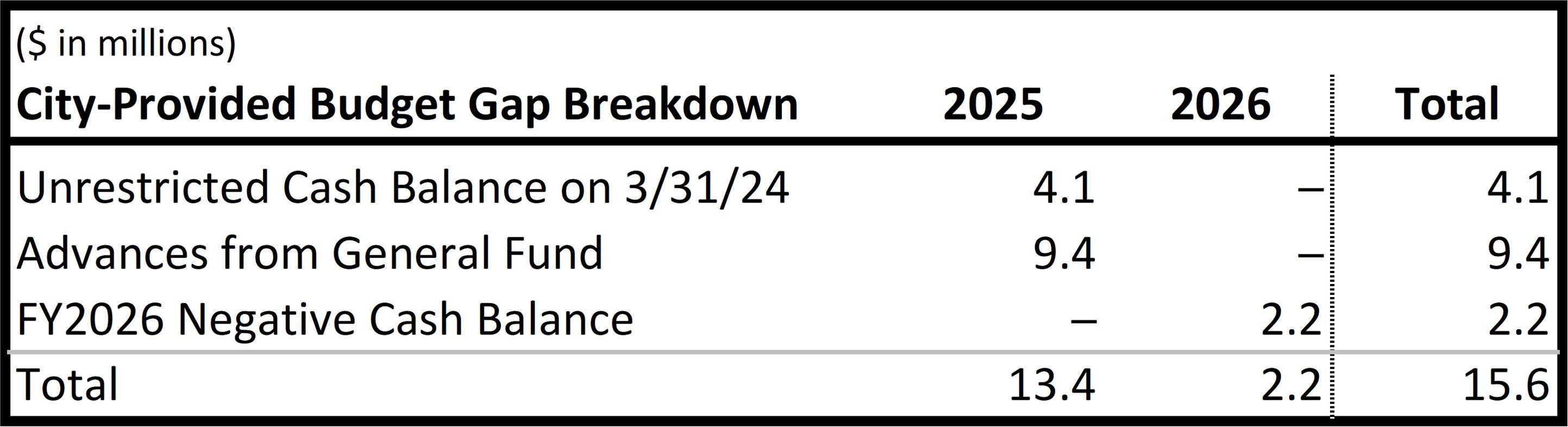
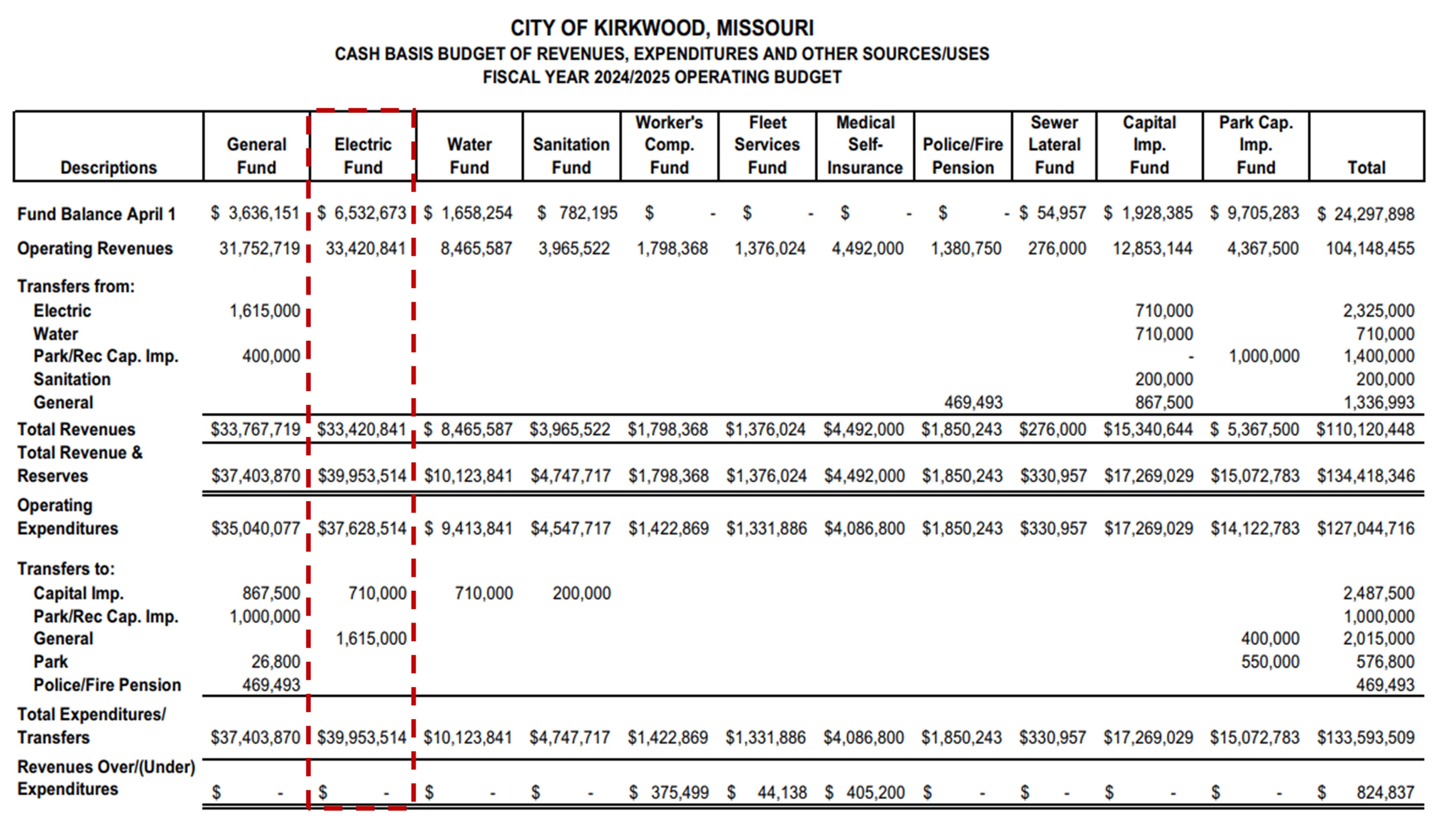
I don’t believe this is an especially useful way to measure the financial challenge, and it doesn’t really match how the report described this figure, which was “expenditures exceeding budgeted levels.” For one, the Electric Department’s 2025 budget already anticipated the use of $6.5 million in reserves to fill the gap between revenues and expenses. Below is a table showing the budget summary across all funds for FY2025. I added the dotted box to highlight the Electric Department.
As another example, in FY2026 the city raised electricity rates partway through the year, though the adopted budget did not assume that increase. That unbudgeted revenue helped offset the cash deficit. If the deficit is treated as the budget miss, this methodology can understate the expense problem in a given year because unbudgeted revenue offsets the cash deficit.
Further, this methodology only looks at FY2025 and FY2026, even though the After Action Report’s explanation points to capital expenditure budget tracking problems that developed over a longer period.
In other words, $15.6 million represents a cash reconciliation, which conflates a variety of underlying factors. It doesn’t show how much electricity costs or capital expenditures exceeded budget, or when those variances occurred. So next, I tried to do that. The table below summarizes my findings.
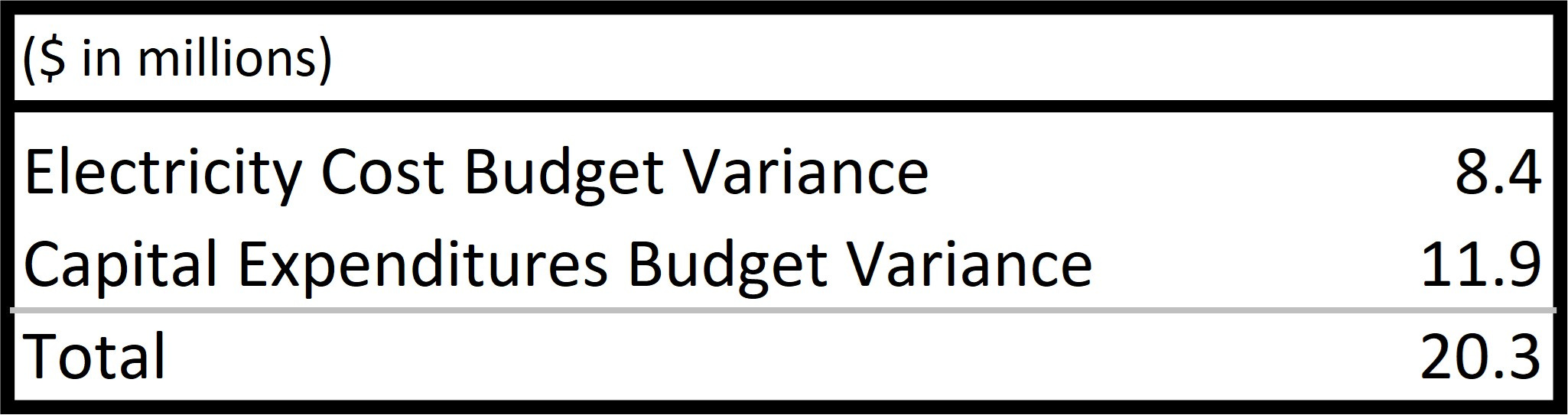
I hesitated putting a total on this table. The total isn’t the important part, and I’m not trying to say the city’s figure is wrong because it’s too low. It’s wrong because it mixes together many different concepts that make it less useful as a tool to understand a problem.
My point isn’t to explain a complex problem with a single number. My point is that you can’t do that. The interesting takeaway to me is the breakdown of the total. As I’ll go on to describe, once the pieces are separated, the story becomes clearer: the electricity-cost miss explains itself; the capital expenditure miss does not.
Electricity Cost
This amount was fairly straightforward to measure. I just subtracted budgeted electricity costs in 2025 and 2026 from actual costs in 2025 and 2026 (the latter obtained via public records request).
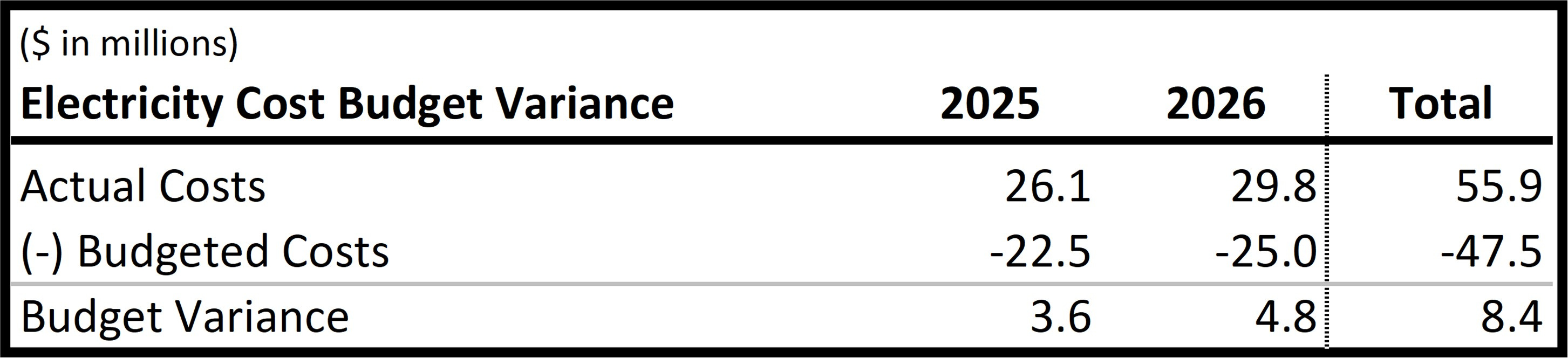
The After Action Report attributed the budget miss to “capacity market volatility.” Overall, I think that explanation is broadly consistent with the data. There isn’t anything that stands out to me here as anomalous.
Starting at a very high level, electricity costs are volatile. The budgeting history shows that the city generally understood the long-term level of those costs. In aggregate, across the ten years before FY2025, actual electricity expense was, on average, 1% below budget.
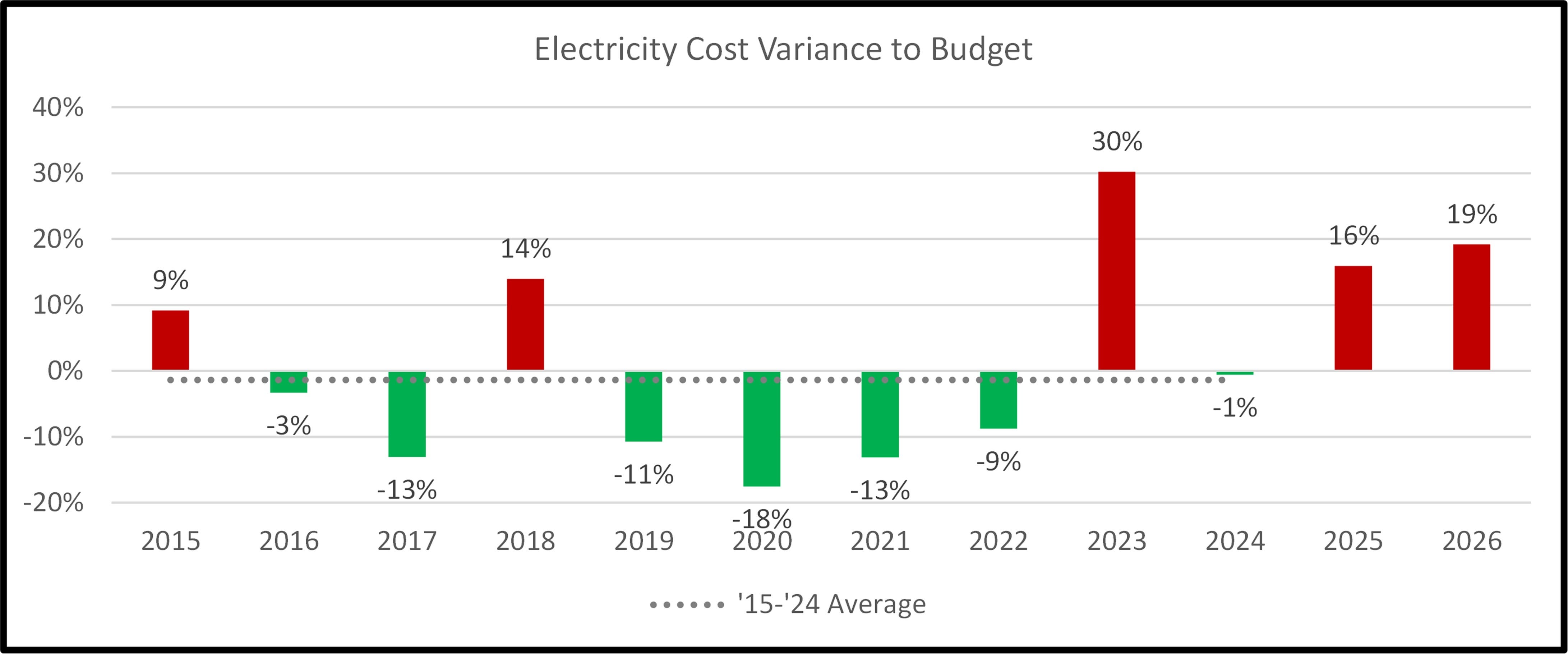
But that average hides a lot of year-to-year volatility. The average absolute variance from budget was about 12% during that period.
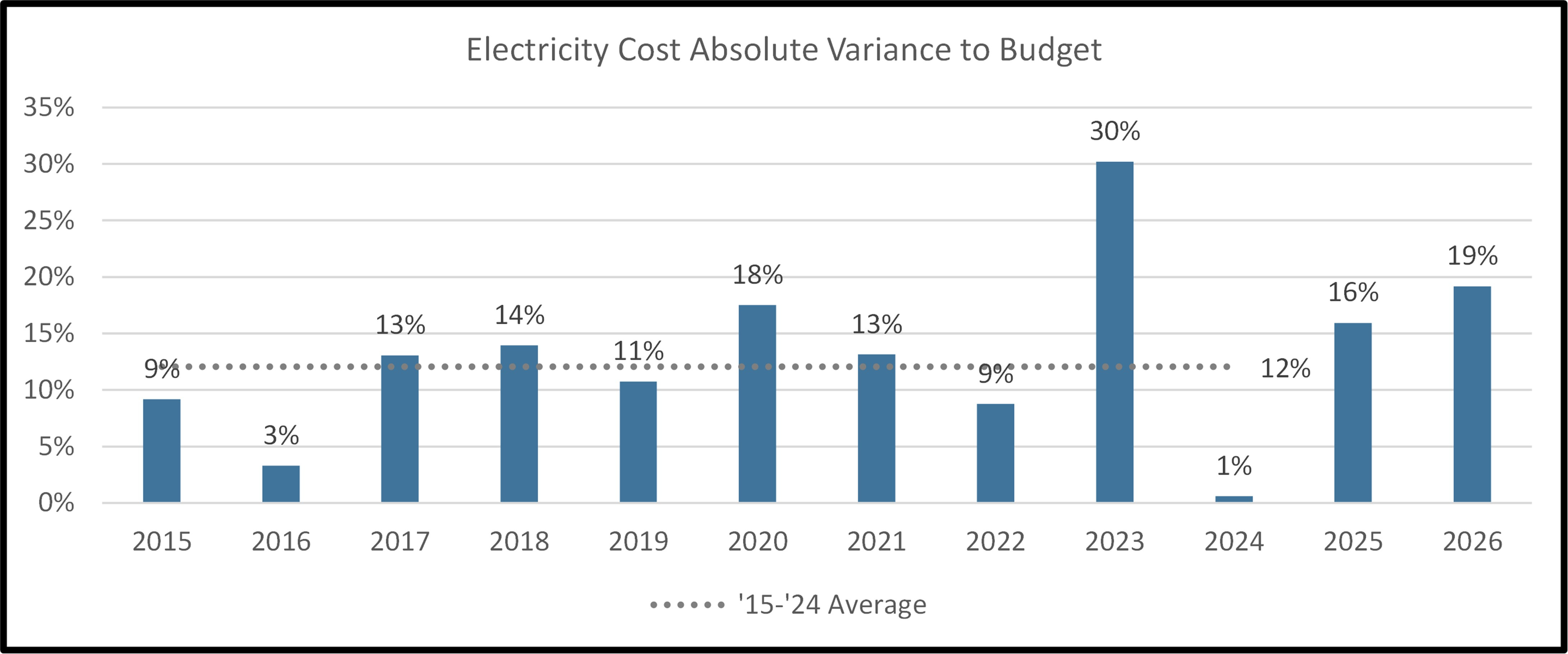
In that context, misses of 16% in FY2025 and 19% in FY2026 were large, but not outliers.
Let’s look more closely at the detail. Electricity costs include the cost to purchase power and the cost to purchase capacity. The former is relatively easy to understand – it’s the cost the city pays to buy the electricity its customers use.
Capacity purchases are less intuitive. But, simply put, it works like this. The amount of electricity we use on a given day varies considerably over the course of a year (and indeed even within a given day). On the peak demand day (typically in the summer when air conditioning use is the highest) we use about 1.5x-2x more electricity compared to an average day. It’s important to be able to purchase enough electricity to meet the demand on any day (or really, at any given moment), including the peak. For that reason, market regulators require utilities to make sure that enough capacity exists to supply their peak demand (plus a safety margin). The mechanism for ensuring this is the capacity market. Utilities pay power producers just to have enough production capacity on standby to serve their peak demand.
This is a bit like renting a backup power generator. Renting a backup generator has two costs. You pay to have the generator reserved and sitting there in case the power goes out, and you also pay for the fuel if you actually run it. Capacity purchases are like the reservation fee. Power purchases are like buying the fuel.
With that background, let’s look at how the city’s electricity costs trended against two variables: 1) a wholesale power price proxy and 2) capacity market prices1.
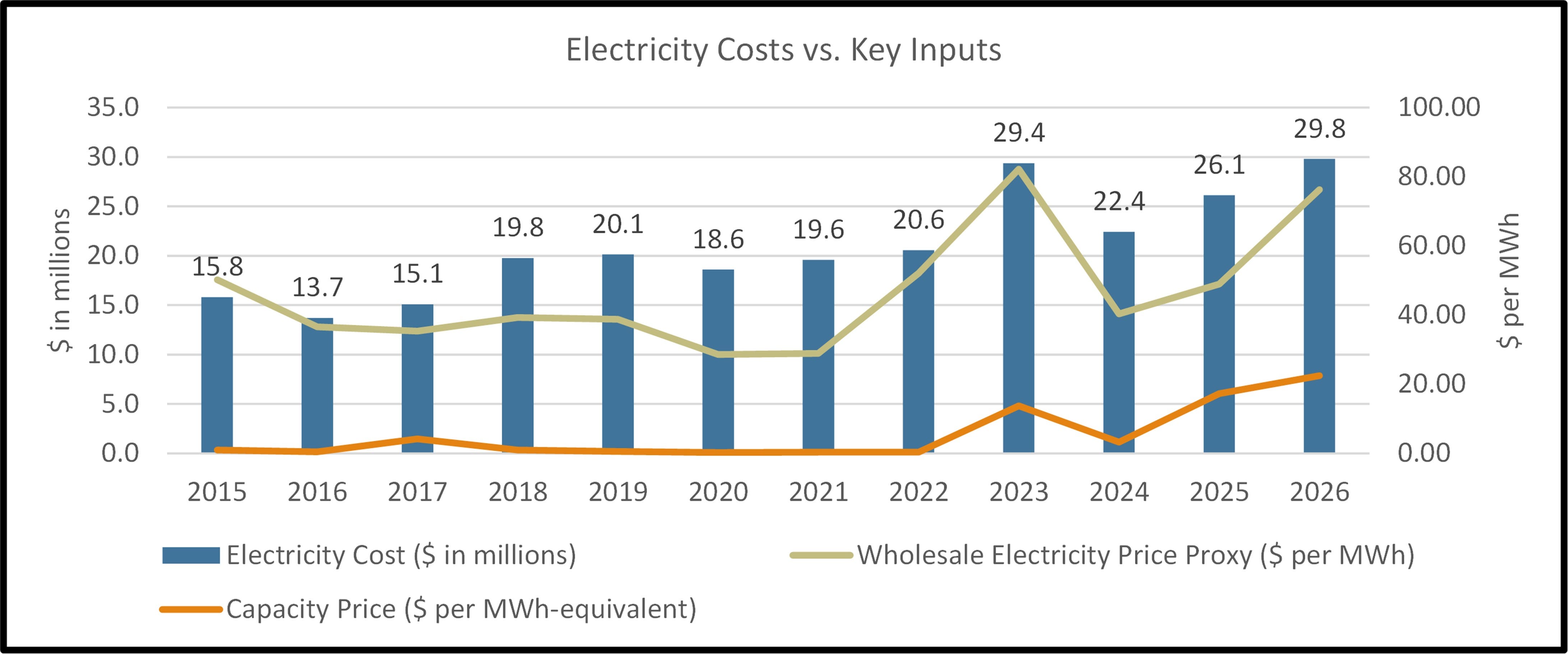
From what I can see, the trends in the city’s electricity costs make sense relative to the trends in the underlying input costs.
I believe the $8.4 million budget miss came from ordinary market volatility. Further, I don’t think the problem is the budget miss itself; electricity costs are volatile. I think the problem is where that volatility sits. I’ve seen the recommendation a few places now (including the After Action Report) that the city should adopt a rate mechanism that passes this volatility through to customers and I agree with that takeaway. The collective balance sheet of the Electric utility’s 10,000 customers has a better capacity to absorb this volatility than the city’s budget. This doesn’t necessarily mean a permanent rate increase. It means rates fluctuate up and down to reflect changes in power costs.
Capital Expenditures
Measuring the budget impact of capital expenditures required a different approach. A one- or two-year budget comparison misses the way capital projects are authorized, delayed, reappropriated, and completed across multiple fiscal years. So I built a capital budget-authority roll-forward beginning in 2018 to determine the cumulative amount of over- or underspending across a longer time-frame.
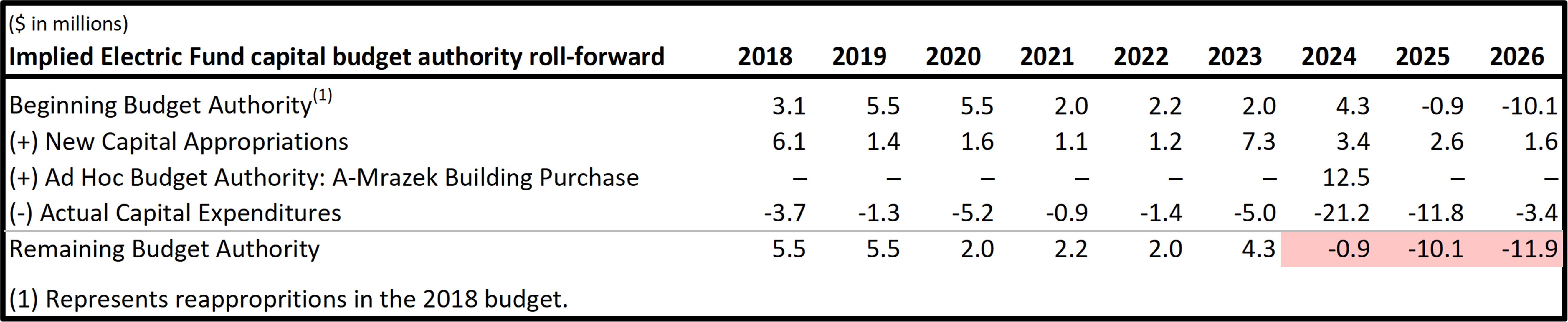
This analysis starts with 2018 reappropriations (spending that was approved in fiscal years before 2018, but not yet spent), adds new budgeted capital appropriations for each year as they occurred, and subtracts actual capital spending. On this reconstructed basis, cumulative Electric Department capital expenditures exceeded identified capital budget authority by approximately $10.1 million by the end of FY2025 and $11.9 million by FY2026.
One note on what this analysis does and doesn’t capture. This roll-forward includes only capital authority identifiable from adopted budgets, reappropriation schedules, and the separately approved A-Mrazek building acquisition. It does not capture any supplemental appropriations or other adjustments that were not apparent in the annual budgets.
There was also a comment in the After Action Report that says the effect of the capital spending was “to advance five to seven years of planned capital investment into a span of two fiscal years.” I think this is saying that the overspending in recent years didn’t just come from previously-approved work, but also pulled forward projects that were meant to occur in future years. It’s hard to see how this fully reconciles with the data.
The FY2026 five-year capital plan outlined $4.4 million of total capital spending in fiscal years 2027-2030. Most of this ($2.8 million) relates to recurring distribution line replacements, which are not the kind of projects that can easily be pulled forward into a single year. But even if you treat the full $4.4 million as additional budget authority, that still leaves you with $7.5 million in cumulative spending beyond the approved budget authority.
I’ll end with this. If the goal is to measure and identify the underlying causes of the budget problem, the city’s $15.6 million figure is too muddled to do that. A cleaner reconstruction points to roughly $20.3 million of identified budget variance: $8.4 million from electricity costs above budget in FY2025 and FY2026, and $11.9 million from capital spending beyond identified public spending authority.
But those two components should not be treated the same way. The electricity-cost miss is broadly explainable as ordinary-course volatility and acute challenges in the power market. The capital-spending shortfall is different. Capital projects should be authorized, tracked, reappropriated, and visible in the public budget trail. On the record I reviewed, that trail does not fully reconcile. That is why the $11.9 million capital figure is the more important number.
This is only a rough approximation of the actual input prices the city incurred. The city’s actual costs depend on things like hedging, power purchase agreements, and bi-lateral capacity contracts. For the wholesale electricity price proxy, I am using EIA’s PJM West wholesale power-price series. This is not the actual price in Kirkwood’s region, but it is a long-running, liquid, downloadable wholesale electricity benchmark.
Additional Issues the Report Should Address
Electric Reserves Were Used in the Leffingwell Acquisition
The analysis does not address the effect of the Leffingwell/Public Works property acquisition on the Electric Department’s reserves and liquidity.
City Electric capital records contain a specific FY2024 entry of $5,278,663 identified as:
“Leffingwell PW site – building.”
That expenditure must be included in any serious analysis of why Electric lacked sufficient liquidity when purchased-power costs increased.
The central question is not simply whether the Leffingwell expenditure was authorized or classified as a capital asset. The relevant financial questions are:
How much unrestricted Electric cash was used at closing?
What was Electric’s reserve balance immediately before and after the transaction?
Was a minimum reserve or liquidity requirement in place?
Did staff evaluate whether Electric could afford to use approximately $5.28 million while simultaneously funding an accelerated system-modernization program?
Was the approaching Rush Island retirement and associated capacity exposure considered before the money was committed?
Were Electric customers and the City Council told that utility resources had been used for the acquisition?
Was there a documented plan and deadline to restore Electric’s reserves?
Without a reserve bridge showing Electric’s cash position before and after Leffingwell, the public cannot determine how much the property acquisition weakened the utility’s ability to withstand the later power-cost increase.
Public Records Do Not Show That the COP Proceeds Repaid Electric
The City subsequently issued approximately $5.73 million in Series 2024B Certificates of Participation connected to the Public Works project. Those proceeds were deposited into a trustee-held project fund, and nearly all of the proceeds were later disbursed.
However, the available public records do not contain the requisition-by-requisition disbursement trail necessary to establish that the COP proceeds reimbursed the Electric Fund for the approximately $5.28 million Leffingwell expenditure.
A debt issuance is not, by itself, proof that Electric was repaid.
To establish repayment, the City must produce:
trustee account statements;
COP requisitions;
wire confirmations;
City general-ledger postings;
Electric Fund cash receipts;
pooled-cash entries; and
the complete closing and reimbursement ledger.
The public record does not presently establish that Electric received reimbursement from the Series 2024B COP proceeds for the approximately $5.28 million Leffingwell expenditure.
The Full Leffingwell Financing Structure Was Not Addressed
The report should also explain that the Leffingwell acquisition involved more than the approximately $5.28 million Electric entry.
Audited records identify a separate $7 million advance from the Park Capital Improvement Fund to the Electric Fund for the acquisition, construction and furnishing of the Public Works facility. Electric carried the corresponding long-term payable.
The FY2026/27 budget shows a planned multi-year repayment stream from Electric to Parks. That continuing obligation indicates that Electric remained financially burdened by the project after the COP financing was issued.
Therefore, the analysis should not treat Leffingwell as an unrelated real-estate transaction. The acquisition affected Electric through:
the approximately $5.28 million Electric capital entry;
the $7 million Park Capital advance carried as an Electric obligation;
COP-related debt-service costs;
internal rental arrangements intended to offset those costs; and
the resulting reduction in Electric’s financial flexibility.
The Report Does Not Reconcile Reserve Depletion by Cause
The City’s $15.6 million explanation combines:
Electric’s prior unrestricted cash;
advances from other City funds; and
the later negative cash balance.
But the report does not provide a reserve reconciliation identifying how much cash was consumed by:
Leffingwell;
accelerated line and substation work;
transformer orders;
other capital projects;
purchased-power costs;
capacity costs;
overtime;
transfers to other City purposes;
debt service; and
operating expenses.
Without that reconciliation, the report cannot establish which decisions depleted Electric’s reserves or when the Department lost the ability to absorb a market shock.
A complete after-action report should contain a month-by-month reserve bridge beginning before the October 2023 Leffingwell acquisition and continuing through the 2025–2026 financial crisis.
Capital Spending Should Be Measured Against Cash and Liquidity, Not Only Budget Authority
The outside report appropriately questions whether capital spending exceeded identifiable budget authority. But legal or budgetary authority is only one issue.
Even an authorized project can create a financial crisis when:
cash is not available;
reserves fall below prudent levels;
contractual obligations are not fully recorded;
several years of work are accelerated;
power-market exposure is increasing; or
no cost-to-complete forecast exists.
The review should therefore determine not only whether the projects were authorized, but whether the City had sufficient liquidity to undertake them.
The Acceleration of Five to Seven Years of Work Was Not Properly Explained
The After-Action Report states that five to seven years of planned capital investment were advanced into approximately two fiscal years.
That statement requires much more detail.
The City should identify:
every project accelerated;
its original scheduled year;
its revised construction year;
its original budget;
its actual and committed cost;
who authorized the acceleration;
the operational reason for accelerating it;
whether Council approved the revised schedule;
and the effect on reserves and purchased-power liquidity.
Without a project-by-project schedule, the statement that future work was merely “advanced” risks becoming a broad explanation for spending that cannot otherwise be reconciled.
The Report Does Not Establish a Functioning Progress-Review Process
A capital program of this size should have included scheduled monthly or quarterly reviews comparing:
approved budget;
actual expenditures;
outstanding commitments;
percentage complete;
projected cost to complete;
revised completion dates;
available cash;
reserve balances; and
future power-purchase obligations.
The City’s own findings show incomplete encumbrances, inconsistent project tracking and suspended quarterly financial reporting.
The report should identify whether formal progress meetings occurred, who attended them, what reports were reviewed, what variances were identified and what corrective action was taken.
If no documented recurring review existed, that is a management deficiency separate from the accounting problems.
The Report Does Not Identify Responsibility at Each Decision Point
The After-Action Report describes systems and procedural failures but provides little detail regarding individual responsibility.
A meaningful after-action review should identify:
who approved individual capital projects;
who authorized acceleration of future projects;
who monitored reserves;
who approved the Leffingwell use of Electric resources;
who reviewed purchased-power exposure;
who was responsible for quarterly reporting;
who received warnings of negative cash;
when the City Administrator was informed;
and when the Council was informed.
Without that information, the report describes what went wrong but does not explain how management allowed it to continue.
The Report Does Not Evaluate Whether Electric Resources Were Used for Non-Electric Purposes
The Electric Fund was involved in financing or supporting broader municipal projects, including Leffingwell, prior advances related to KPAC/Park/community-center purposes and capital-dividend funding for streets.
The report should determine whether those uses:
were permitted by City policy and law;
were supported by written interfund agreements;
carried repayment terms;
included interest;
were approved publicly;
were disclosed to ratepayers;
and were repaid as scheduled.
The financial condition of Electric cannot be evaluated accurately without accounting for money transferred, advanced or committed outside the utility’s core electric-service function.
The Rate Increase Must Be Reconciled to the Actual Causes
The City should identify how much of the later electric-rate increase was intended to cover:
future purchased-power costs;
capacity costs;
rebuilding reserves;
repayment of interfund advances;
Leffingwell obligations;
COP debt service;
accelerated capital spending;
and ongoing operating expenses.
Electric customers should be told whether higher rates are paying for electricity service, restoring reserves depleted by prior management decisions or financing broader municipal projects.
Analysis of Electricity Costs
The report appropriately challenges the City’s explanation of the $15.6 million financial problem and raises important questions regarding capital spending. However, it does not apply the same level of scrutiny to the approximately $8.4 million increase in electricity costs.
Instead, the report largely accepts the City’s explanation that the increase resulted from “ordinary market volatility.” That conclusion is incomplete because it overlooks one of the most important questions: What did Kirkwood know in advance, and what actions did it take to prepare?
Ameren publicly announced the planned retirement of the Rush Island Energy Center approximately one year before the plant closed on October 15, 2024. The retirement of one of the region’s largest generating facilities should have prompted a comprehensive review of Kirkwood Electric’s exposure to future capacity costs.
The issue is not whether the exact market-clearing price could have been predicted. It is whether City management recognized that removing more than 1,100 MW of generation from MISO Zone 5 created a foreseeable supply-and-demand risk requiring advance planning.
The report never asks whether Kirkwood used that one-year warning period to:
* evaluate the expected impact on MISO Zone 5 capacity prices;
* forecast its future purchased-power exposure;
* secure replacement capacity through bilateral or forward contracts;
* review its hedging strategy;
* evaluate reserve adequacy and liquidity;
* prepare for potential collateral or margin requirements;
* postpone discretionary capital spending to preserve cash;
* recommend temporary rate adjustments or a power-cost adjustment mechanism; or
* provide regular risk assessments to the City Council.
These questions are central to evaluating management performance.
The After-Action Report focuses extensively on accounting deficiencies, purchase-order controls, blanket contracts and project tracking. While those findings are important, it provides very little information about the Electric Department’s power-procurement strategy or its energy risk-management practices during the period leading up to the capacity crisis.
The report also concludes that the regional capacity shortage was identified during routine contracting in the fall of 2024. If a major regional generating plant had been scheduled to close approximately one year earlier, why wasn’t that risk already part of the City’s planning process?
That omission deserves as much scrutiny as the accounting deficiencies.
The report further recommends implementing a power-cost adjustment so future market volatility can be passed through to customers. A power-cost adjustment may be appropriate, but it should not become a substitute for prudent utility management.
Customers should not automatically bear costs that may have resulted from inadequate planning, delayed procurement decisions, insufficient reserves, or failures in risk management.
The same rigorous analysis applied to capital expenditures should also be applied to purchased-power decisions.
The report carefully reconstructs the history of capital spending and asks whether expenditures exceeded public spending authority. It should ask the same questions regarding purchased power:
* What risks were identified?
* When were they identified?
* What mitigation strategies were considered?
* Which actions were approved?
* Which actions were rejected?
* Who made those decisions?
* Were those decisions consistent with the City’s energy risk-management policies?
Until those questions are answered, it is premature to conclude that the approximately $8.4 million increase in electricity costs was simply the result of ordinary market volatility.
A complete review should distinguish between unavoidable market conditions and management decisions. One is an external event. The other is a matter of governance, planning, and accountability.
The absence of this analysis is one of the most significant shortcomings of both the After-Action Report and this independent review.